Mr Kcal · Allot Tech (Suzhou) Co., Ltd.
Equipment selection & integration

PET Bottle Filling Equipment Starts With the Bottle Supply Decision

The PET route changes significantly depending on whether bottles are purchased or blown in the factory. Bottle design, neck finish, temperature and pressure suitability affect the entire equipment chain.

Direct answer

What equipment is needed for a PET beverage project?

A preliminary route may include preform handling and blow molding or bottle receiving, bottle unscrambling, air conveying, rinsing-filling-capping, cap feeding, inspection, labeling, coding, conveying and packing.

Purchase decision evidence

Freeze the bottle and neck basis across every module.

Blowing, air conveying, rinsing, filling, capping, labeling and packing must use the same controlled PET package.

DecisionConfirmEvidence
Bottle sourcePurchased bottles or in-house blowingBottle/preform drawings and samples
Neck and capControlled neck finish and closureOne approved drawing revision
Bottle behaviorWeight, stiffness and temperature/pressure dutyHandling and filling trial
Format rangeEvery bottle, label and packChange-part and changeover matrix
PET bottle-source comparison

Compare purchased bottles and in-house blowing as different equipment scopes.

The bottle-source choice changes storage, air conveying, utilities, quality responsibility and the interface presented to the rinser-filler-capper.

DecisionPurchased empty bottlesIn-house blowingEvidence to compare
Container supplyReceiving, storage and unscramblingPreform handling, blowing and air conveyingApproved bottle/preform drawings and samples
Factory demandWarehouse and internal transport spaceBlower, compressor/cooling interfaces and maintenance accessScaled layout and point-of-use utilities
Quality ownershipIncoming bottle inspection and supplier controlPreform, heating, blowing and bottle inspection controlDefect criteria and release plan
Format changeBottle family and unscrambler guidesMolds, neck parts, recipes and air-conveyor compatibilitySKU/change-parts matrix
Filler handoffStable bottle orientation and pitchNeck-handled bottle transfer at agreed conditionInterface height, direction, rate and accumulation

Decision boundary: The comparison is equipment-specific; it is not a complete factory investment or bottle-manufacturing business case.

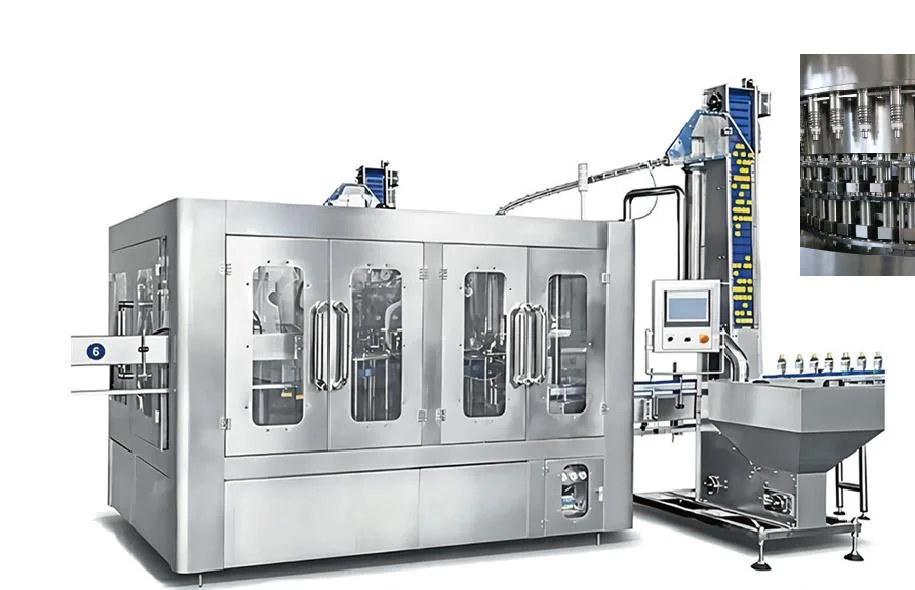
Automatic rotary still-water rinsing filling and capping machine
Still-water rinser-filler-capperStill-water filling reference; the final valve count, bottle and closure handling remain project-specific.
01

Choose purchased bottles or in-house blowing

This choice changes factory space, high-pressure air, cooling, molds, preform logistics, bottle buffer strategy and investment scope.

  • Bottle source
  • Preform and resin basis
  • Mold scope
  • Air and cooling utilities
02

Qualify the bottle for the product

A water bottle is not automatically suitable for hot fill or carbonated beverage pressure. Bottle and closure approval belong in the project basis.

  • Bottle drawing
  • Neck finish
  • Temperature requirement
  • Pressure requirement
03

Protect lightweight bottles downstream

Guide rails, transfer, accumulation, labeling and packing must keep unstable bottles controlled without excessive pressure or scuffing.

  • Bottle stability
  • Conveyor pitch
  • Label application
  • Pack pattern
Equipment dependency

Read the page as a connected equipment graph.

Every equipment decision has an upstream condition, a current function and a downstream handoff.

01Upstream

Approved preforms, bottles and closures with the required utilities.

02Current equipment

Orient or form, convey, rinse, fill and cap.

03Downstream

Inspect, label, code, accumulate and pack stable bottles.

Evidence boundary

Catalog reference where supported. Project confirmation where required.

The supplied Allot Tech 2026 catalog supports named equipment groups such as water treatment, beverage preparation, CIP, bottle handling, filling platforms, labeling, conveying and secondary packaging. It does not make every module mandatory for every project.

VERIFIED

Company identity, contact route, named equipment categories and catalog reference flows.

REFERENCE

Application routes and model-family context from the supplied catalog.

REQUIRES CONFIRMATION

Output, power, dimensions, materials, components, process conditions, availability, price and service scope.

PROHIBITED

Invented performance, price, certifications, projects, reviews, factory claims or guarantees.

Buyer questions

Frequently asked questions

These answers frame the equipment decision. The final process and equipment remain project-specific.

Is a blow molder always required?

No. It is not required when approved empty bottles are purchased and supplied reliably.

Can one PET bottle design serve water, hot fill and carbonated drinks?

Not automatically. Product temperature, pressure, handling and shelf-life requirements must be confirmed.

Next purchase decision

Send the known facts. Keep every unknown visible for technical confirmation.

Review My PET RouteTalk About My Project →